


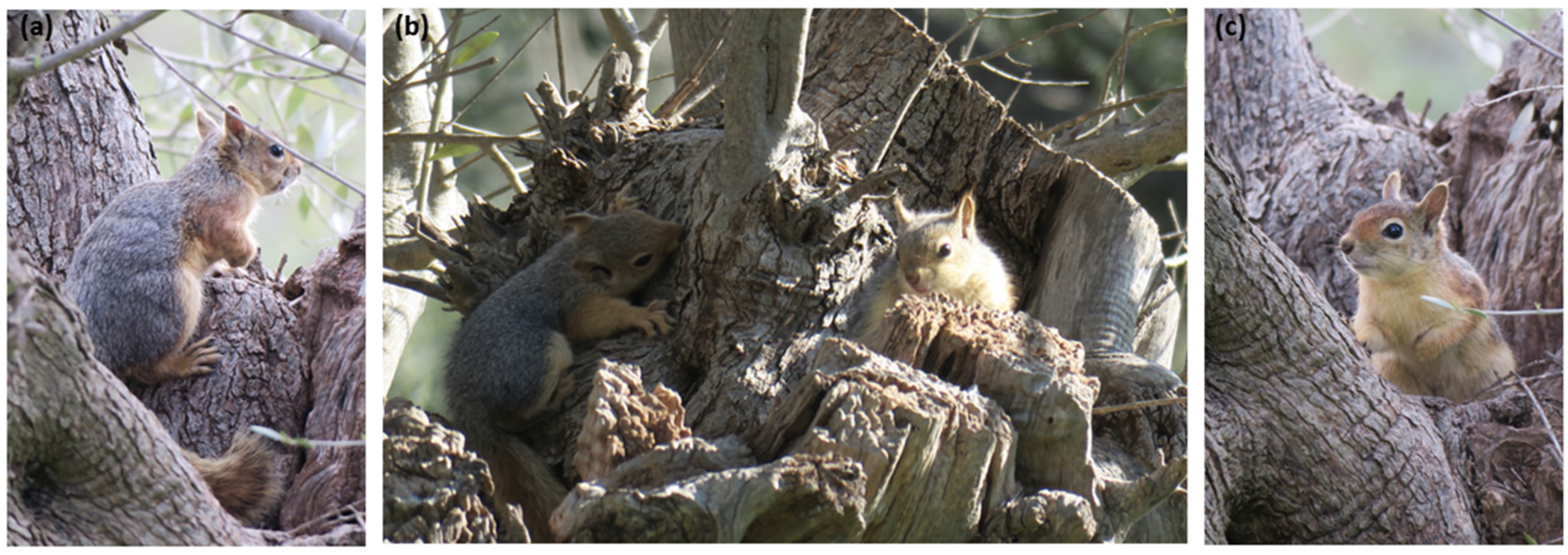
Zevgolis Y.G., Kamatsos E., Christopoulos A., Valeta C.*, et al. (2025), A Squirrel’s Guide to the Olive Galaxy: Tree-Level Determinants of Den-Site Selection in the Persian Squirrel within Traditional Mediterranean Olive Groves. Biology, 14(12), 1676.
*Ms Christina Valeta is a student in our M.Sc. programme “Global Environmental Change, Management & Technology”, Direction: Research in Environmental Sciences)
Traditional centennial olive groves represent ecologically complex agroecosystems that combine agricultural use with high conservation value across the Mediterranean Basin. On Lesvos Island, Greece, which is the westernmost limit of the Persian squirrel’s (Sciurus anomalus) natural range, these centennial olive trees provide essential nesting refuges. To identify the factors guiding den-site selection, we measured structural, physiological, and thermal traits of 288 olive trees, including 36 confirmed den trees. Squirrels consistently selected older and taller trees with extensive crowns, high leaf area, and elevated photosynthetic performance, traits that enhance canopy productivity and promote a more stable microclimate. Infrared thermography further revealed that den trees exhibited lower orientation-related temperature asymmetries, reflecting stronger thermal regulation at the trunk level. Integrative modeling identified crown development and trunk thermal stability as the most decisive predictors of den occupancy. These results demonstrate that centennial olive trees function as important biophysical refuges, reinforcing the need to preserve traditional olive landscapes as key habitats for arboreal mammals in Mediterranean ecosystems.